
Trade Anatomy - short vol in EWY
Post Mortem Signal Du Jour 20260219
Two weeks ago we were highlighting an opportunity to short volatility in EWY. We were at the time pointing to the recent resolution of arguably the biggest political crisis South Korea has faced since the 1980s, when then-president Yoon Suk Yeol attempted a coup and was ultimately removed from power. His sentence to life in prison was well received by the market and vol crashed almost immediately after that, and even if the outcome of the sentencing was pretty well known in advance, it just goes to show the weight that event had on the market. If you needed a reminder, you could have a look at December 2024 and see how Korean equities performed back then.
We were also pointing to the fact that Kospi is mostly driven by one stock: Samsung, and the correlation between Samsung and Nvidia tends to be quite strong. At that time, the NVDA earnings were expected a week after, and we were convinced that some extra vol premium was embedded in there. In the end, there was some; yet, this is a position that has been stressful, depending on how you entered it: we entered a few days before the publication in the Signal du Jour with our Discord group as our indicators were flashing short signals, and managed to exit on the Thursday when vol collapsed. But if you entered after that, the relentless climb in Korean equities must have been hard to bear: the Kospi has almost tripled over a year, and the buying pressure was particularly felt post trial announcement and ahead of earnings.
And while in the end, the recent geopolitical developments have helped bring back the position on the winning side, this is a great example that yes, timing matters in option trading (if you haven’t done it yet, you should subscribe to our analytics platform and get access to timely signals) and that delta is your biggest enemy.
Let’s have a look.
The trade
In our Signal du Jour two weeks ago, we highlighted a short volatility opportunity in EWY, specifically the 120/150 strangle for the March 20th expiry.
At the time, the probabilities were strongly in our favor. The likelihood to see implied volatility exceed realized volatility was sitting at 72%

Most importantly, we knew there was a significant chance to see implied volatility go down from there. The real unknown was on the realized volatility front. It could have gone up or down, we had no strong opinion about it. In the end, realized volatility went up, and implied volatility, after an initial crush went up quite a bit.
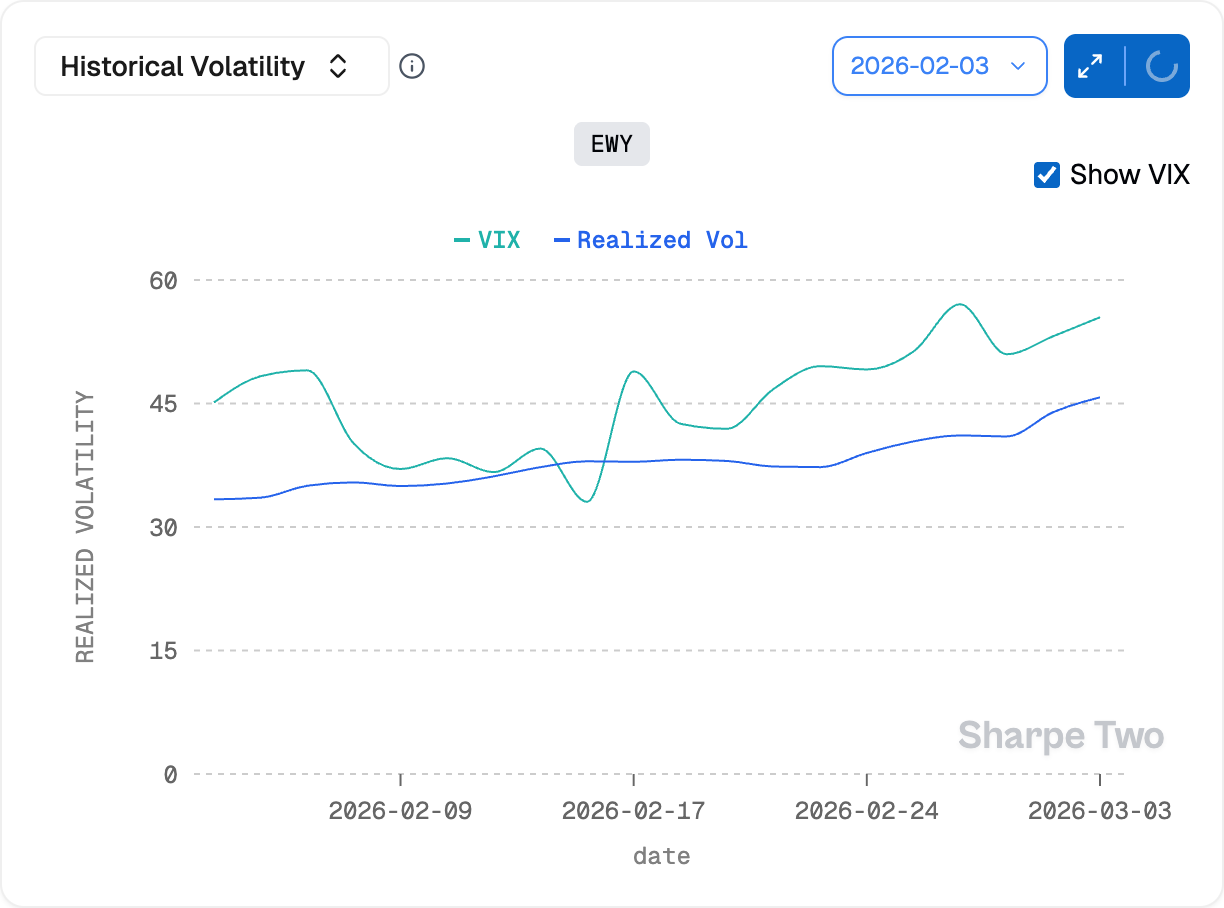
You may ask what happened there: the geopolitical context was still normal, and arguably korean equities were going up, not down? Well it is mostly because implied volatility in Kospi is driven by the call side, and the popular products that are autocallables: after the verdict, the demand for puts diminished which triggered the movement down in implied vol. But it then went up driven by the rise in the index.
The rise in the index was ultimately what made that position difficult to keep
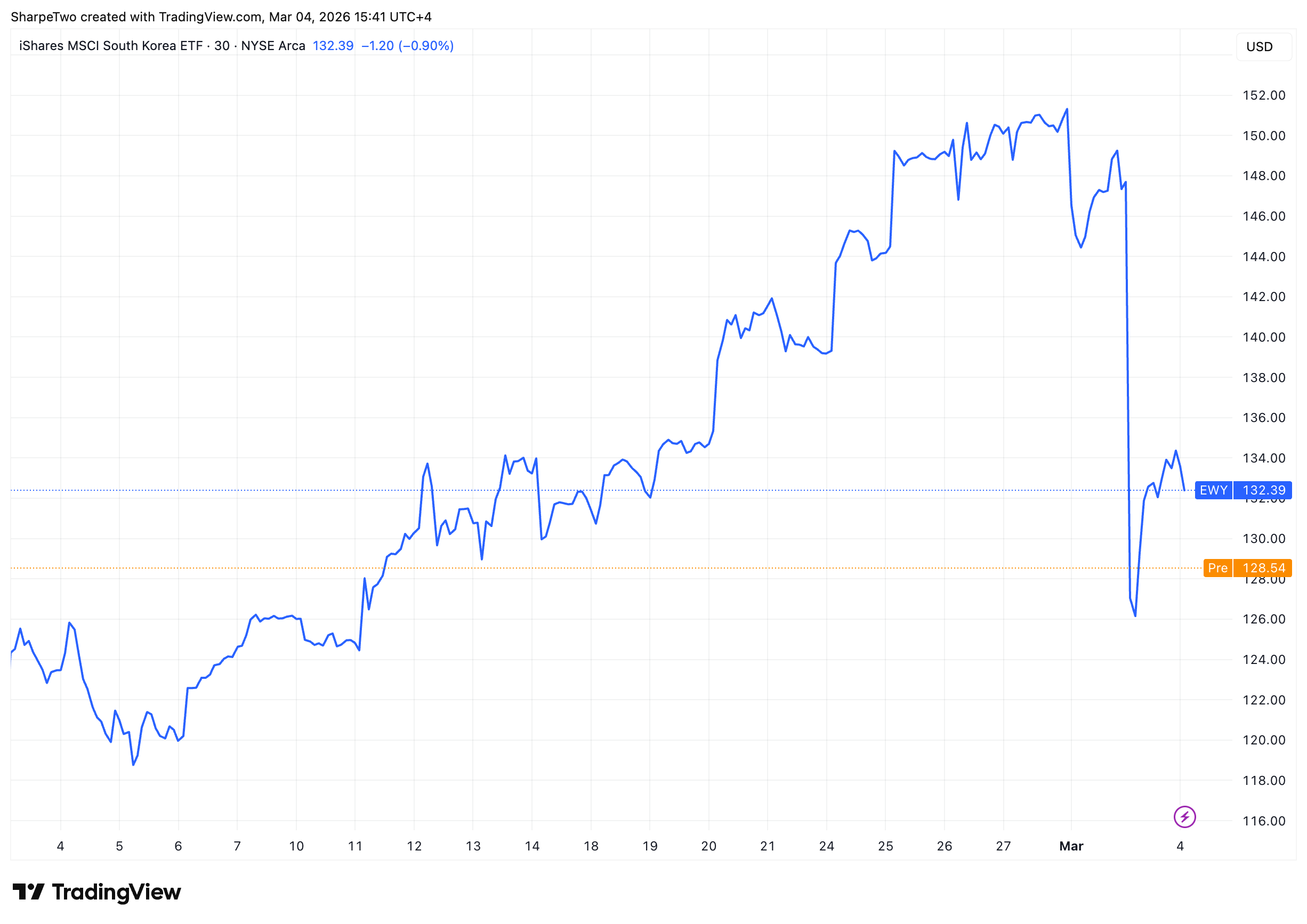
We entered at roughly 133 and after about a week, the call side was breached. And if it wasn’t for the recent escalation of the conflict in the middle east and the broad equity sell-off that came up with it, this trade could have resulted in a loss. Instead we will get away with a scratch, although, if you still have the position on, you should be able to make money today as the market stabilized.
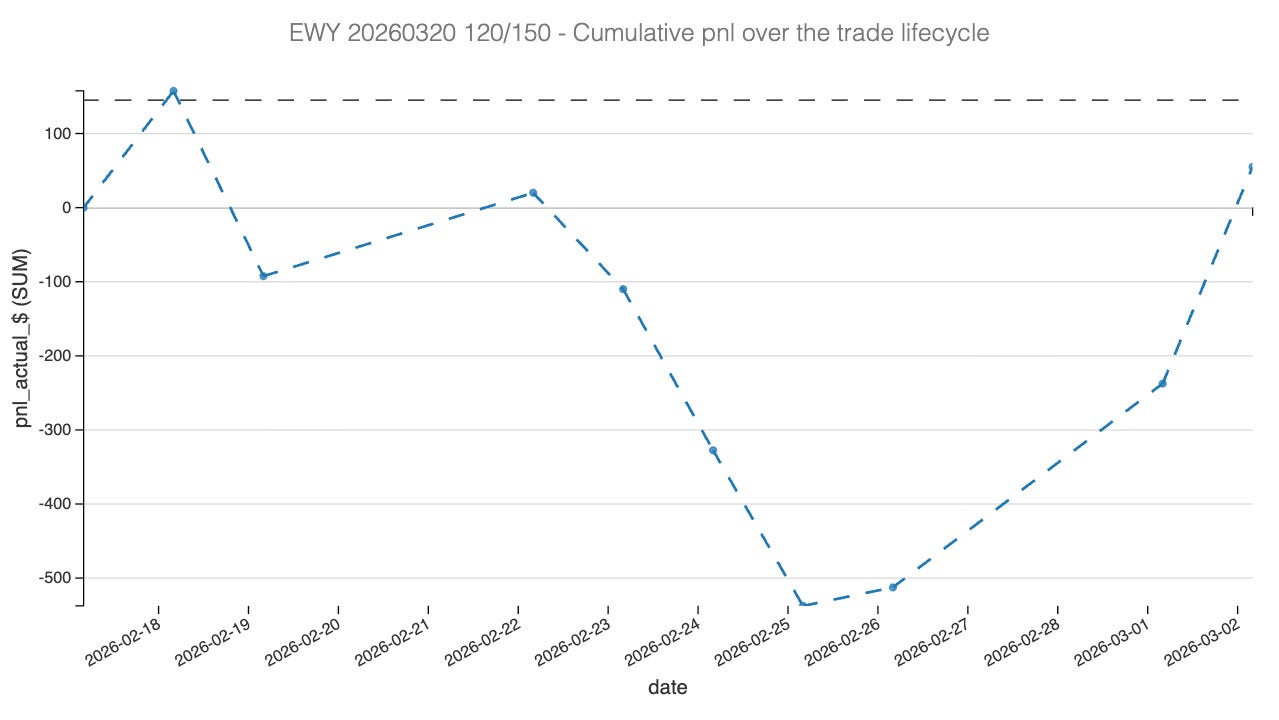
Let’s not mistake this for a win. The variance risk premium was there but the vega headwind from rising implied volatility consumed most of it and the delta round-trip in delta made the difference between a loss and a scratch purely a matter of circumstance: had the underlying stayed above $150, the outcome would have been materially different.
Yet, we can only publish one article per week, having access to the signals as soon as they arise is also why we encourage you to join us and our Discord Group to make the most of these situations as soon as we flag them.
Let’s now move on to the Greek PnL attribution.
The Greeks PnL Attribution
Looking at the attribution, this trade was a battle between Theta and Delta, with Vega acting as the persistent headwind that turned a potential win into a scratch.
As expected with any short premium strategy, time decay provided the primary source of profit. Theta accumulated approximately $350 over the two-week holding period, a steady daily contribution that performed exactly as designed. This is rent collection: it does not care about the headlines, it simply accrues.
Delta was the dominant source of PnL volatility. The cumulative delta contribution swung from a brief positive of +$140 on the first day to −$530 at the worst point, before recovering entirely to near zero. The daily attribution chart isolates the critical sessions: February 25th and 26th saw massive negative delta bars as the underlying rallied through our 150 strike, while March 2nd and 3rd saw equally large positive bars as the underlying collapsed back to entry level.
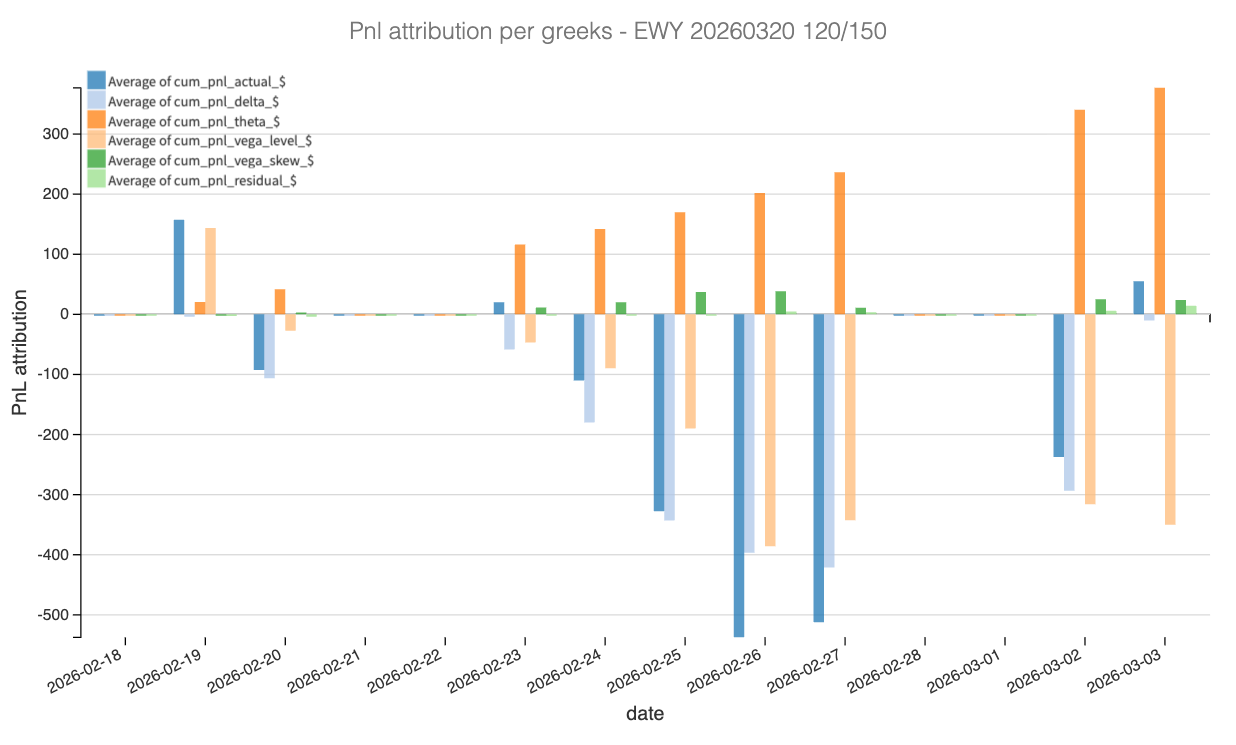
Vega remained a persistent headwind throughout. The cumulative vega loss peaked at −$430 as implied volatility expanded during the rally, settling around −$300 by the trade’s end. Even as the underlying pulled back, IV repriced higher across the curve. This is why the trade ended as a scratch rather than a meaningful win: theta generated $350, vega consumed $300, and delta returned to roughly zero.
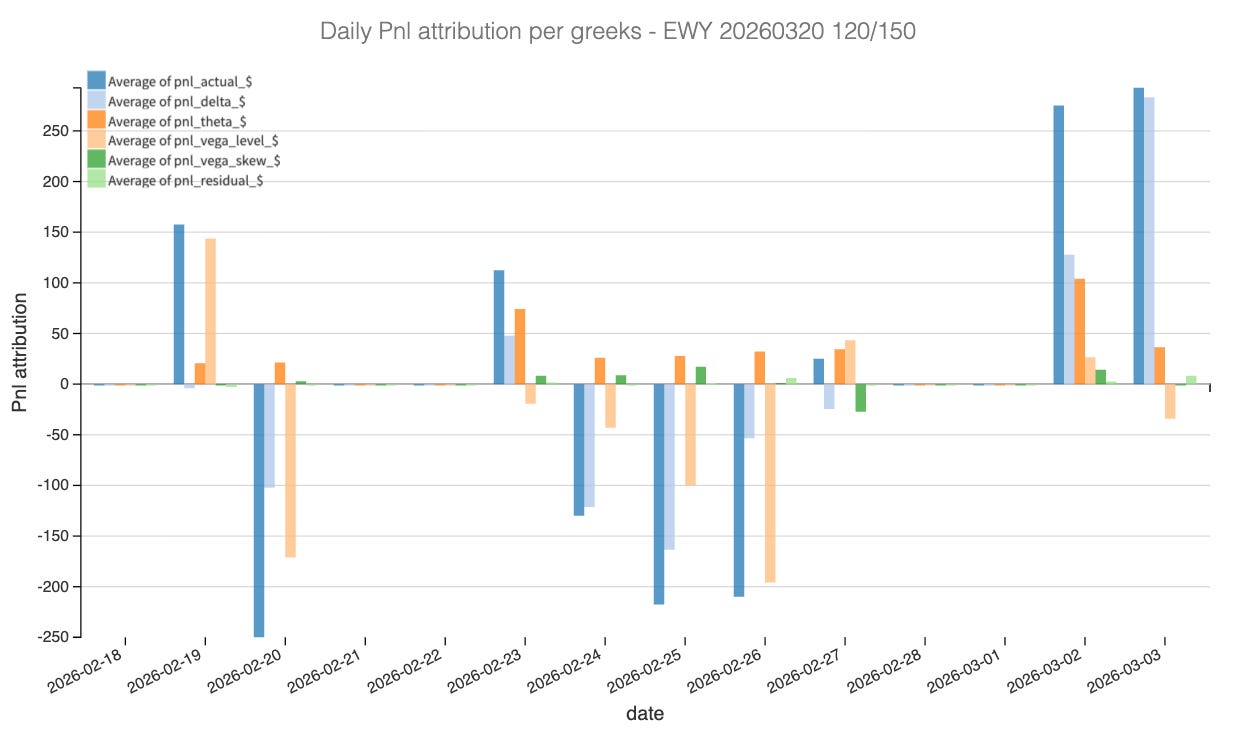
The residual was negligible throughout, confirming that our Greek approximations were accurate for this trade.
The takeaway is mechanical: when delta is the dominant Greek and you choose not to hedge, the PnL becomes a function of the underlying’s path rather than your volatility thesis. The theta was real. The vega headwind was manageable. But the delta swing of nearly $700 peak-to-trough dwarfed both, and the fact that it round-tripped to zero was a matter of circumstance, not strategy.
Now the question: should we re-enter this position? Or potentially keep the one we have on? Let’s have a look.
