Forward Note - 20260308
That escalated quickly.
What a week it’s been. Despite holding up fairly well early in the week as the markets were hoping for a quick and swift resolution, the lack of clarity and obvious second part of the planned attacks against Iran soured the mood. The results are pretty gloomy: the SP500 lost a little bit more than 1% while the QQQ limited the damage to just over 0.5%.

The VIX spiked to finish right under 30 as people rushed to find insurance contracts ahead of a weekend that promised to be quite eventful. Oil is now in a league of its own, adding a sheer 20% in just Thursday and Friday as it became evident that a swift resolution was out of the question. While the Iranian Foreign Minister opened the door to a deal, and so did President Trump, the mood turned sharply on Friday when the US president asked for “total surrender” as the only acceptable outcome.
The market can absorb shocks. They did it so many times before and are a formidable engine of resilience. Yet the best way to grip that engine is uncertainty. That is the one currency markets really do not deal with very well and at the moment, we have a lot of it and as a result, we are back in extreme stress territory.

We obviously won’t comment much on when and how that uncertainty will resolve. The only thing we will say is we are of the opinion that this military campaign comes at a fantastic time, as US and Chinese delegations must prepare next week, the actual state visit of Trump in China, at the end of the month. And what a nice way to start negotiation with a price of oil close to $100, at a time when China has already announced they will show the lowest level of growth over the last 30 years, at 4.5 to 5%.
Now that we have said that, our post will be similar to last week; the goal at that stage is not to be a hero and make some call about the top on oil, or for a goal that interests us a little bit more, the top in VIX. Things can and usually get worse before they find some sort of resolution, when one camp, the american, the iranian, the Gulf countries, China, someone blinks. Can we go to VIX 40 next week? Absolutely. And therefore, the primary goal is to protect your capital in such an environment: if you can survive the spikes and the period of heightened volatility, you may often have done the hardest part of the job.
Therefore, like last week, start by a thorough review of your delta exposure and your vega exposure. It is worth making a separate focus on USO as it is now moving on its own. The implied volatility is, as one would expect, at the highest point we have observed since Covid.

When we wrote about it for our signal du jour on Wednesday, IV was already at a staggering 64%; it is now sitting at 92%. This is uncharted territory and it is more advisable to either hedge some volatility exposure, or if your account cannot handle it, close the position altogether. Being caught in a spike happens. Not doing anything about it, is what makes the difference between blowing up an account and surviving.
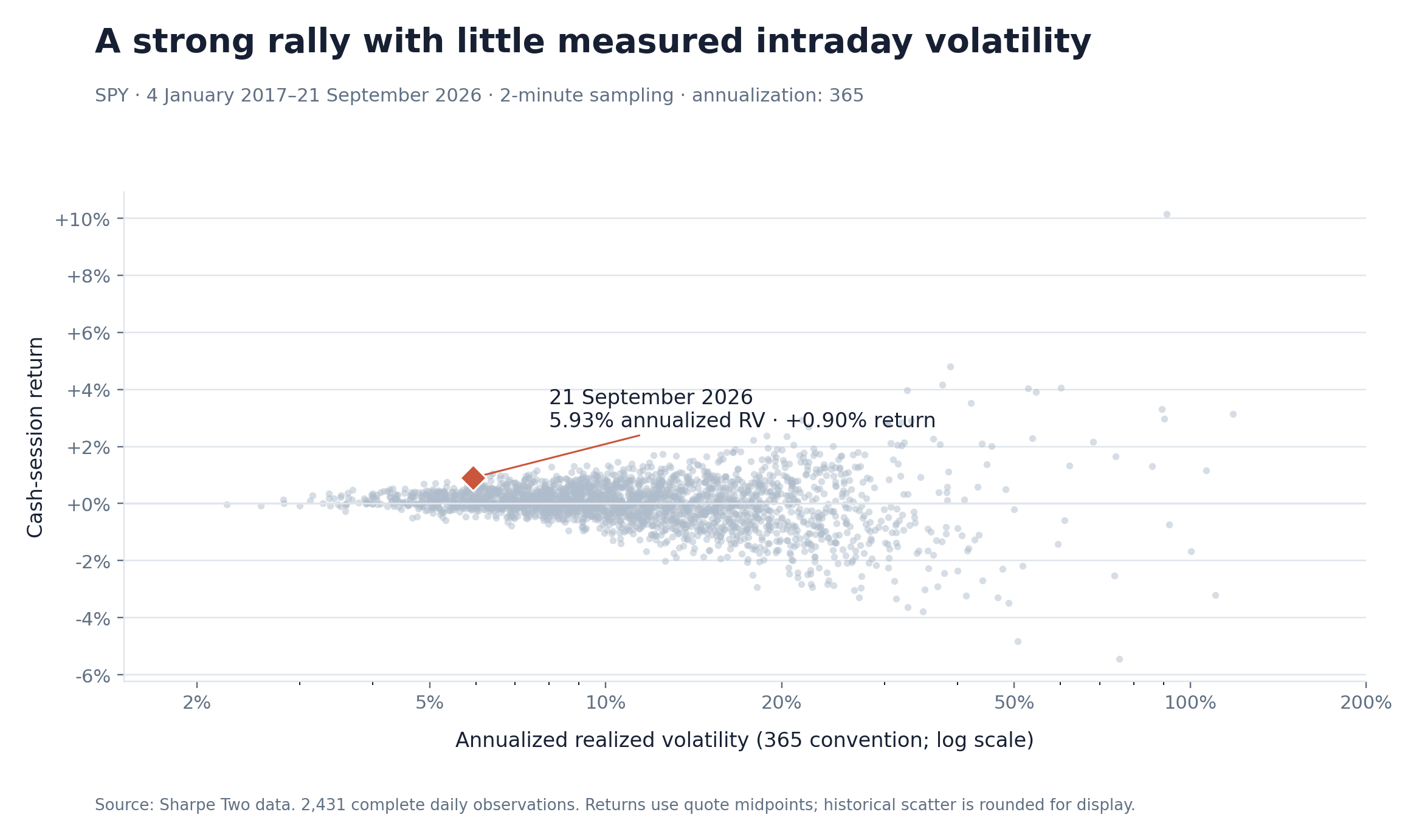
While it is obvious that implied volatility can get higher, so can realized volatility. As you can see, we are still about 20 points below Q1 2022 and the beginning of the Ukraine war. Therefore, if you already have a delta problem you also must do something about it.
Now let’s assume you want to keep the position or are not forced out of it: the advantage of a crazy situation like this is that you can often find refuge in the longer expirations.

The volatility at 6 months is also nearing 60%; there is a legitimate case where you take all your oil positions and recenter them to 6 months from now and forget about it. And if you needed some sort of hedge or relief, you could buy the one year out. That backwardation is one of the steepest we’ve seen, and while it could stay like this, a normalization would see the 6 months react much more than one year out.
The same can be said about US equities if this is the only thing you trade: at VIX 29, the VRP is very pronounced, but the level of uncertainty is also growing. If a really expensive oil is not great for China or Europe, it is also not great for the US and inflation immediately comes to mind. Add to that the fact that the economy unexpectedly destroyed 92 thousand jobs in February and all of a sudden, a year that was supposed to be under the stamp of deals and pro business is again put on the sideline.

As a result, puts are extraordinarily expensive at the moment, to the point where your 20 delta put is twice as expensive as a 20 delta call. You see where we are going with this…? Yes, risk reversals. Obviously things can get worse before they get better, and one will have to be extra cautious on the delta side if he wanted to build a risk reversal: we used to do 30 delta put versus 20 delta call, when markets are normal: switching to 15 delta put and 10 delta call seems to be appropriate to the circumstances. Doing it at 1 month doesn’t give such an extra advantage and once again, looking further out at 3 or even 6 months to find refuge and wait for the storm to pass, may be the best idea.
We are dealing again with extraordinary circumstances and great opportunities appear for those who still have the ability to act. We insist on this: make sure you are in a position to trade when things start to settle down.
In Other News
When geopolitics is not spilling all over our social media feed, the little space left is often occupied by AI. We’ve left you last week with a bitter feud between Anthropic and the Pentagon and it looks like they are back at the negotiation table. In the meantime, we learnt late this week that the head of Robotics at OpenAI decided to quit as using robots with lethal weaponry outside of human control was not something he could align with. This is the stuff we used to see in science fiction, or more recently, in this (absolutely tragic) episode from Black Mirror where a woman is relentlessly chased by a robot-dog to finally meet her fate. Well, it is not anymore. And this is happening right now. While the use of drones is becoming normal in the new military warfare (the UAE sends us now regular alerts and destroy about 100 of them everyday above our head, as we speak) what happens to civilians when 500 of these robots are parachuted in a city clearly not prepared for such encounters? This still sounds like science fiction? Of course it does. Except, it really is not anymore, and while we are the first one to have a ton of fun with Claude Code, the world order is changing at an extremely fast pace and demanding answers from politicians and governments on the military use of AI is important.
Not in a naive way: of course they will develop advanced weaponry with these systems. But drones and missiles are ineffective here in the UAE because (to our pleasant surprise) they quietly prepared for years. Military budget in Europe has been sacrificed for austerity and social progress. Are we equipped to protect these social progresses at a time when human and societal progress is in jeopardy?
Thank you for staying with us, and as usual, here are two interesting reads from last week:
If you are not using AI in 2026, you are missing out on turning yourself into a much more productive version of yourself. There isn’t a single white collar job that isn’t being touched, from finance, to design and marketing and after years of making fun of ChatGPT, it may be time to wake up to the new reality: these things are here to stay. So nothing better than an article about how the creator of Claude code uses Claude code to see how you could integrate it into your own workflows.
And here is to lighten the mood in these tense times. In this hilarious article, you will see how the author empowered his AI assistant, his instance of himself in OpenClaw (how are we supposed to call these things) to miss out on 450k of unrealized gain due to… a mistake from the bot. Pretty revealing of what the world in 20 years may look like…
That is it for us this week, we wish you a (de-escalating) week ahead and as usual happy trading.
Ksander